
RFID vs EAS: one counts, one guards.
Both technologies put a radio tag on merchandise, and that is roughly where the resemblance ends. One knows what every item is and where it sits. The other stands at the door and asks a single question: is a live tag passing through. The two are easy to confuse and worth keeping straight.
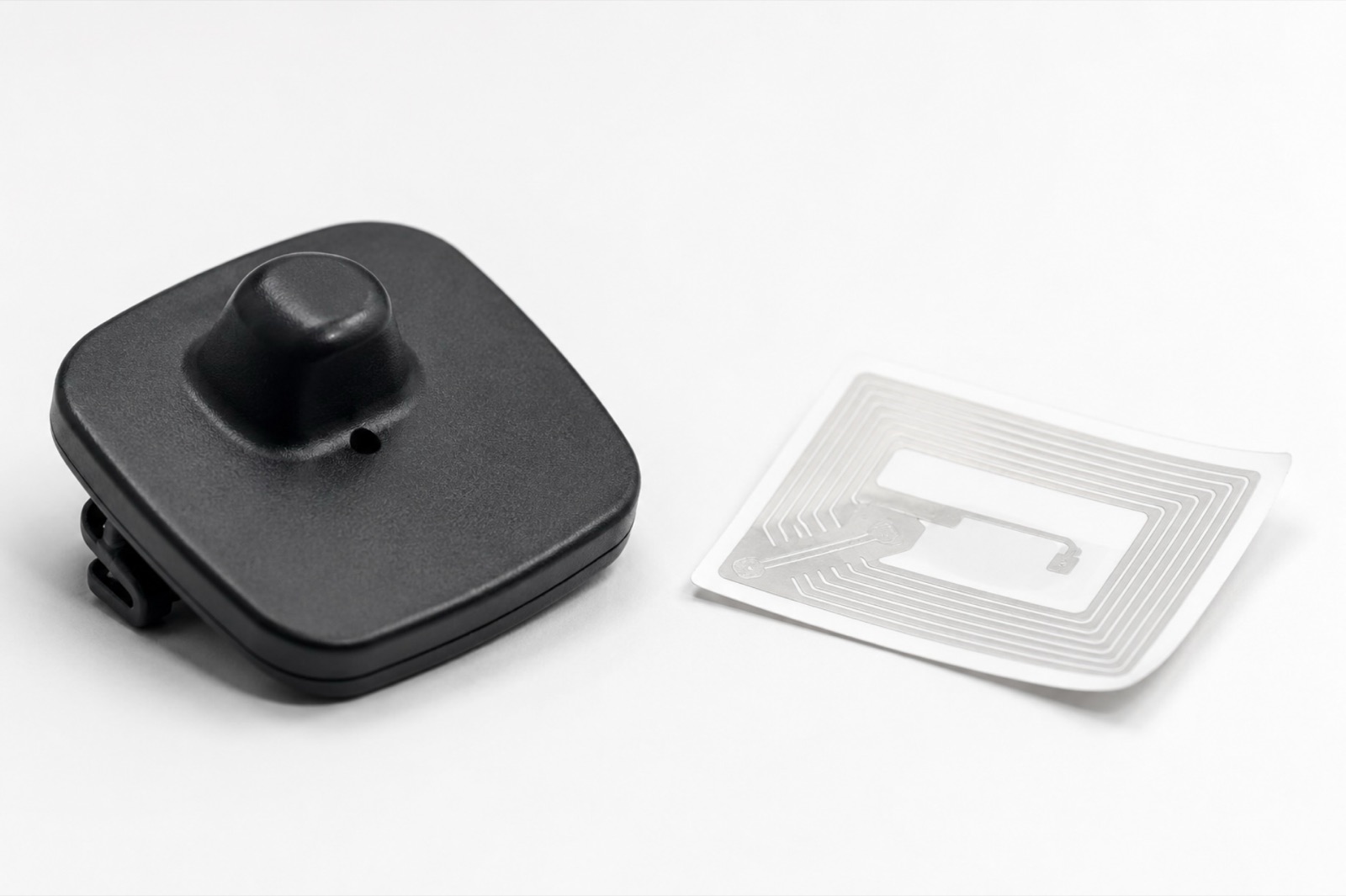
Two Different Questions
Electronic article surveillance and radio frequency identification get lumped together because both rely on small radio tags attached to merchandise, and because vendors market them side by side. But the systems were built to answer different questions.
EAS answers a question about presence: is an active tag inside the detection field at the exit right now? It does not know, or care, what the item is. The pedestal at the door hears a tag respond and sounds the alarm. That is the entire transaction.
RFID answers a question about identity: which exact items are on this shelf, in this stockroom, in this carton? Every RFID tag carries a unique serial number, so a reader does not just hear "a tag." It hears "this specific black medium jacket, and that one, and that one," many tags in a single pass, without needing to see any of them.
Put simply: EAS is a security technology that guards the door. RFID is an inventory technology that counts the building.
How EAS Does Its Job
An EAS system is a closed loop of three parts: a tag or label on the merchandise, pedestals at the exit that transmit a field and listen for a response, and a deactivator or detacher at the point of sale. Radio frequency (RF) systems listen for a resonant reply at 8.2 MHz. Acousto magnetic (AM) systems listen for a brief ringing at 58 kHz. When a live tag crosses the field, the alarm sounds.
The tag's job ends at the door, and so does its intelligence. It has no serial number to report and no memory of where it has been. That simplicity is also EAS's strength: tags are cheap, hard tags can be detached at the counter and reused for years, and the deterrent effect is visible to everyone who walks past the pedestals. We cover the full system anatomy in our EAS field guide.
How RFID Does Its Job
Retail RFID runs on passive ultra high frequency (UHF) tags, operating in the 900 MHz range in North America under the EPC Gen 2 standard, the flavor of the technology the industry brands as RAIN RFID. Passive means the tag has no battery: it borrows energy from the reader's signal and uses it to answer back with its stored serial number, the Electronic Product Code (EPC).
Because each tag reports a unique identity, and because a reader can sweep up tags in bulk without line of sight, RFID changes what an inventory count costs. A stockroom that takes a full shift to count with a barcode scanner can become a walk through with a handheld reader. Counts can happen weekly or even daily instead of once or twice a year, and the store's record of what it owns starts matching what is actually on the floor. That accuracy is the product. Everything else, ship from store, better replenishment, fewer phantom stockouts, follows from it.
The hardware and software side of this, readers, printers, labels, and the counting workflow, is its sister discipline to what this journal usually covers. For the inventory half of the story, Retail Security Group's dedicated property covers RFID inventory tags, readers, and software at rfidinventorytags.com, including a plain language learning library on how RFID counting works.
Where They Meet: the Exit
The two worlds collide at the door, because an identity system can be taught to do a presence system's job. If every item is RFID tagged and the software knows what has been sold, a reader at the exit can, in principle, recognize an unsold serial number walking out and raise an alarm. Some retailers with mature item level programs run exactly this kind of RFID exit detection, a question we take up in depth in Can RFID Replace Your EAS Pedestals?
In practice, most stores that install RFID keep their EAS at the door, for a few stubborn reasons:
- Coverage. RFID exit detection only works if every item that can walk out carries an RFID tag. EAS pedestals alarm on any live EAS tag, including the ones applied at the factory through source tagging programs that have run for decades.
- Deterrence. A visible pedestal and a visible tag change behavior before any theft happens. An overhead RFID reader is invisible to the person deciding whether to conceal an item, and a system nobody notices deters nobody.
- Certainty at the alarm. An EAS alarm means a live tag is at the door now. An RFID exit event depends on sales data being current and the read being clean, and a false alarm rate that is acceptable for inventory is a different conversation at the exit with a customer standing there.
- Shared weaknesses. Both technologies are radio, and both can be interfered with by shielding. A foil lined bag muffles an RFID inlay for the same reason it muffles an EAS label, a subject we covered in the booster bag dispatch. Benefit denial layers like ink tags stay relevant precisely because they do not depend on any signal at all.
The direction of travel is not either or. It is convergence: the major tag ecosystems now offer dual technology tags and labels that pair an AM or RF EAS element with an RFID inlay in one housing, so a single tag guards the door and feeds the count. Hard tag platforms increasingly ship RFID ready, the CableTrac tag in our own reference pages among them.
Sold, Deactivated, Killed
The checkout tells the difference between the systems as clearly as the exit does. An EAS label is deactivated on a pad at the counter, and a hard tag is physically detached; either way the tag goes quiet and the pedestal ignores it. An RFID tag is usually not touched at all. The sale is recorded in software, and the item's serial number simply moves to the sold list. The EPC Gen 2 standard does include a kill command that can permanently silence a tag, but day to day retail practice mostly leaves tags alive and lets the database do the talking.
That difference matters operationally. EAS security lives in the physical tag state, which is why detachers and deactivators are controlled equipment. RFID security lives in data, which is why an RFID exit system is only as good as the integration behind it.
What a Store Should Take From This
If the problem is shrink at the door, EAS remains the direct tool: pedestals, tags, deactivation, deterrence. If the problem is not knowing what is in the building, RFID is the direct tool, and no amount of EAS hardware will fix an inventory record. A store wrestling with both problems, which is most stores, should treat them as two layers of one program rather than a choice.
On the EAS layer, refurbished equipment keeps the entry cost low: bench tested pedestals and reusable security tags are available as refurbished EAS equipment at securitytagstore.com. On the RFID layer, rfidinventorytags.com handles the counting side. And for retailers heading the other direction, closing locations with tagging programs already installed, Retail Security Group buys used EAS equipment out of liquidations.
One journal, two radios, and a door where they meet. Knowing which question each one answers is the whole trick.